The Bridge
Bride of AlvarThe Bridge is the unstable passage between Earth and Axus, and its decisive significance lies in making every movement between the worlds an existential gamble. It carries Lucy Hammond into Underland, later returns her to Earth, and determines when Saul can invade again. More than a portal, it is a threshold where bodies, relationships, political arrangements, and identities are stripped of their former certainty and forced into new forms.
Definition and Physical Experience
The Bridge is not presented as an ordinary road or doorway but as a dangerous interworld space whose behavior cannot be fully predicted. Alvar bears a scar that he attributes to its unpredictability, yet he also says that he knew it would open during Lucy’s twenty-second year when he first met her mother. That combination of uncertainty and precise timing gives the Bridge a double character: it is mysterious in operation, but its cycles are consequential enough to shape long-term plans. Its opening threatens everyone because it can expose Earth to Axus, prompting Alvar to seek a way to close Earth off from the other world.
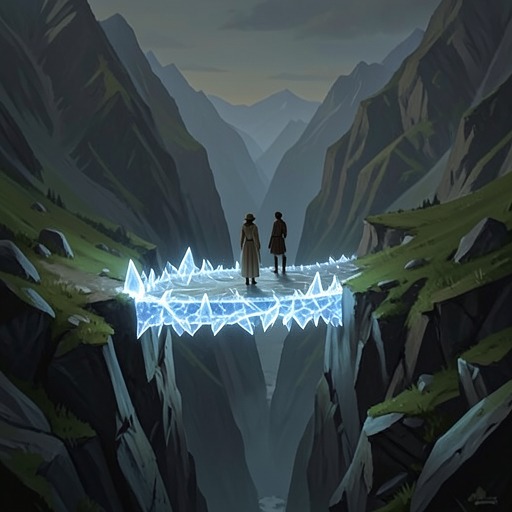
Lucy’s first crossing makes the Bridge’s material strangeness immediate. Alvar touches her forehead with a glowing white crystal and embraces her before her world erupts into white oblivion. The transition carries them through a cold black space suspended within the surrounding whiteness, while lights pass them without producing an ordinary sense of motion or place. There is no echo in Lucy’s voice, and the silence makes the passage frightening rather than wondrous. The Bridge therefore functions as a liminal environment in which familiar physical expectations—distance, sound, direction, and solid ground—temporarily cease to protect the traveler.
At the end of the passage, Alvar raises the crystal and produces a circular window ahead of them, a dark opening sharply contrasted with the Bridge’s white expanse. Through it lies Axus, a planet different from Earth but sufficiently similar in gravity and atmosphere to make the transition survivable. The pair launches through the portal and lands together on soft, velvety grass. The landing establishes a recurring visual pattern: crossing the Bridge begins in disorientation and ends in a field that offers temporary physical safety, even though the political and emotional dangers of Axus remain.
Rules, Timing, and Danger
The Bridge imposes a strict temporal structure on the story. It cannot be opened every day; travelers must wait for the correct cycle. When Alvar and Lucy seek answers from Sola Brightfeather, Alvar explains that Saul will not return until the next bridge opening and estimates that they have at least five days. The Bridge thus becomes a political clock. Its cycles determine the interval before Saul’s return, limit the time available for preparation, and turn geographical separation into a measurable but narrowing reprieve.
Its greatest danger is the possibility of permanent loss. Alvar insists that Lucy hold him tightly because anyone lost in the Bridge is lost forever. His warning initially sounds to Lucy like an excuse for physical closeness, but the passage itself proves that the danger is real: the Bridge is a space in which separation has no reliable recovery. This rule also gives Alvar’s embrace a significance beyond romance. It is simultaneously protection, navigation, and a temporary resistance to the Bridge’s power to erase travelers from both worlds.
The Bridge’s danger is connected to the boundary between Earth and Axus. Alvar’s concern that Earth must be closed off reflects more than a desire to control travel; an opening can permit the return of tyranny and the spread of forces that threaten both societies. When he later announces that Saul is returning, the prospect is tied to the next bridge opening, making the portal the hinge between private rescue and public catastrophe. The same passage that once brought Lucy to Axus can also enable Saul’s renewed oppression of Underland.
Crossings and Ritual Transformation
Lucy’s first crossing is inseparable from her imposed marriage. Her mother reveals that Alvar once promised to save Lucy’s life in exchange for her being given to him as an Earth-human bride. The Bridge consequently links a private bargain made before Lucy’s birth to a public relocation into Underland. Her passage is not merely travel; it is the physical completion of an arrangement that has governed her life without her consent.
That transformation is reinforced by the wedding that follows. In Underland, Lucy is led by Fletch down stairs into a chapel-like space while her mother carries the train of her wedding dress. Hundreds of people wait inside, their whispers and mutters forming a collective pressure around the ceremony. A human priestly figure blesses the couple, gives Alvar a gold goblet, and then places it in Lucy’s hands so that she must drink what remains. The Bridge has moved Lucy from Earth into a society whose customs she does not understand, and the wedding ritual attempts to fix her new position within that society before she has emotionally accepted it.
The passage also intersects with bodily and social metamorphosis. Alvar’s red eyes become visible during the crossing, and his use of the glowing crystal marks him as someone capable of manipulating forces unavailable to Lucy’s world. Later, Lucy is brought through a related threshold under radically different circumstances: blindfolded and assaulted by fear, she discovers that she is outside on the mountains of Ferar beneath full moons, beside the crushed body of a gobli and a horrific dragon-like creature. The contrast between the first crossing’s intimate embrace and this later revelation shows that movement across Axus’s thresholds can lead either to union or to monstrous exposure.
Return, Separation, and Political Consequences
Lucy eventually crosses back to Earth by holding the crystal tightly and thinking of home. The crossing again occurs in a flash of white light, but its emotional meaning has changed. On arrival she finds herself in the same kind of soft grass where she and Alvar first landed, dressed as an Earth woman and once more visibly out of place in the magical world. The repeated landscape makes the return resemble a reversal of the original journey, yet Lucy is no longer the same traveler. She recognizes that she possesses a power of her own and concludes that Alvar did not need to send her away to save her because she could have saved him earlier.
The return does not restore the old world. Lucy smells smoke and sees an amber glow on the horizon, realizing that Saul is already using Alvar. The Bridge has brought her home only to reveal that home is no longer a sufficient refuge. She runs toward the fires, taking the road rather than crossing the fields or jungle, and soon encounters a wagon drawn by a large jungle cat and a voice that sounds like a snake. The portal therefore converts separation into renewed responsibility: Earth may be physically safer, but Lucy’s knowledge of Axus and her bond with Alvar compel her back toward the conflict.
The Bridge also structures the possibility of final separation. Lucy’s departure is framed as a goodbye, but the act of gripping the crystal preserves a connection between thought, object, and passage. The crystal serves as the immediate instrument of crossing, while the Bridge remains the larger force that turns a farewell into an irreversible-looking movement between worlds. Yet Lucy’s return demonstrates that separation is not necessarily closure. The same route can carry a person away from danger and back toward it when the demands of love, power, and political survival change.
Narrative and Thematic Significance
As a threshold, The Bridge organizes the book’s recurring movement from one identity into another. Lucy crosses from daughter to promised bride, from Earth outsider to participant in Underland’s dynastic crisis, and from exile back into active resistance. Alvar’s history is likewise bound to the passage: his attempt to protect Earth from Axus, his dependence on carefully timed openings, and the threat of Saul’s return all make the Bridge a political instrument as well as a supernatural one.
Its symbolism is grounded in concrete danger rather than abstract metaphor. The Bridge offers no neutral passage between equivalent destinations. It subjects travelers to cold, darkness, silence, uncertain direction, and the possibility of being lost forever; then it deposits them into a world where the consequences of arrival are immediate. The portal’s repeated white light and recurring grassland create a visual rhyme between departure and return, while the changed circumstances reveal that no crossing can simply be repeated. Each journey alters what Earth, Axus, home, marriage, and rescue mean.
The Bridge’s most important function is therefore to make transition irreversible in knowledge even when travel can be reversed in space. Lucy can return to Earth, but she cannot return to the ignorance she possessed before learning of Alvar, the bargain made before her birth, the dangers of Cursed blood, and Saul’s use of Alvar. The Bridge is the book’s passage between worlds, but it is equally the mechanism that prevents its central characters from remaining psychologically or politically confined to the worlds from which they began.